Market Insights
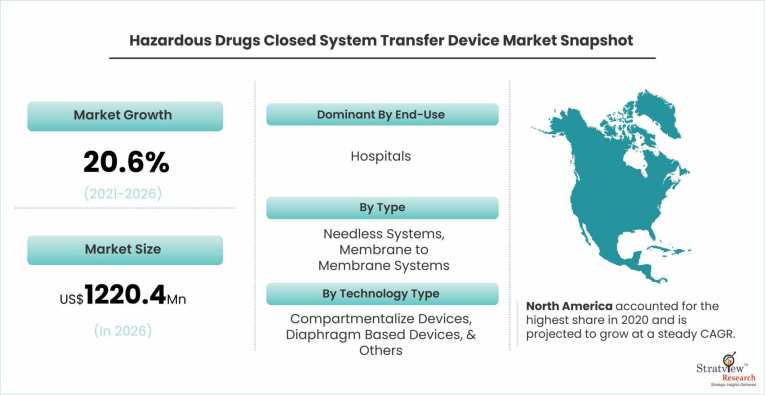
The Hazardous Drugs Closed System Transfer Device Market was estimated at USD 398.5 million in 2020 and is likely to grow at a CAGR of 20.6% during 2021-2026 to reach USD 1,220.4 million in 2026.

Wish to get a full scope of the study? Click here.
What are Hazardous Drugs Closed System Transfer Devices?
The hazardous closed system drug transfer devices (CSTDs) protect hazardous vapor or drugs during drug production and administration. It consists of components that enable the filtering of dangerous vapors out of the system. These devices play a critical role in the protection of healthcare professionals from harmful medications and antineoplastics, which are primarily used in the treatment of patients suffering from chronic ailments.
COVID-19 Impact
The outbreak of the COVID-19 virus has moderately affected the hazardous drugs closed system transfer device industry. The ongoing COVID-19 pandemic is expected to leave a strong impact on the development of the hazardous drug closes system transfer device (CSTD), during the review period, particularly in the first half.
The chain of pharmaceutical supplies across the globe is affected by the lockdown coupled with the rigorous border control and the fluctuation in the global economy can also be considered as a key cause. Though the supply chain of the pharmaceutical lines has resumed worldwide, the industry participants are likely to focus on the supply chain in the prospective months.
|
Global Hazardous Drugs Closed System Transfer Device Market Report Highlights
|
|
Market Size in 2026
|
USD 1,220.4 Million
|
|
Market Size in 2020
|
USD 398.5 Million
|
|
Market Growth (2021-2026)
|
CAGR of 20.6%
|
|
Base Year of Study
|
2020
|
|
Trend Period
|
2016-2019
|
|
Forecast Period
|
2021-2026
|
|
Dominant Region
|
North America accounted for the highest share in 2020 and is projected to grow at a steady CAGR during the assessment period.
|
Key Players
Key players operating in the global market are
- Becton, Dickinson, and Company (BD) (The U.S),
- ICU Medical, Inc. (The U.S),
- B. Braun Melsungen (Germany),
- JMS Co., Ltd. (Japan),
- Equashield LLC. (The U.S),
- Teva Pharmaceutical Industries Ltd. (Israel),
- Corvida Medical (The U.S),
- Yukon Medical (Canada),
- Codan Medizinische Geräte GmbH & Co Kg (Germany), and
- Victus, Inc. (The U.S).
Market Dynamics
Rising importance on the implementation of occupational health and safety standards by the government authorities are providing opportunities to the market players.
- In addition, increasing the adoption of chemotherapy and the improvement of regulatory guidelines regarding hazardous drugs across the medical organizations in the world, further augment the market growth.
- Also, the growing number of chemotherapy and related harmful drug approval is likely to bolster the need for closed system transfer devices.
- However, the poor regulatory guidelines regarding health workers' safety in developing nations are likely to hinder the industry expansion.
Want to have a closer look at this market report? Click Here.
Segment Analysis
By End Use Type
By end use, the hazardous drugs closed system transfer device market has been segmented into hospitals, oncology clinics and centers, and others.
Under these, the hospital's segment garnered the highest market share in 2020 and is projected to register a substantial CAGR during the review period.
This is mainly attributed to the increasing cancer patient pool, robust financial capabilities of hospitals for purchasing high-priced CSTDs when compared to oncology centers, and the growing need to comply with the regulatory guidelines established by the NIOSH and FDA regarding the safety of healthcare providers.
Regional Insights
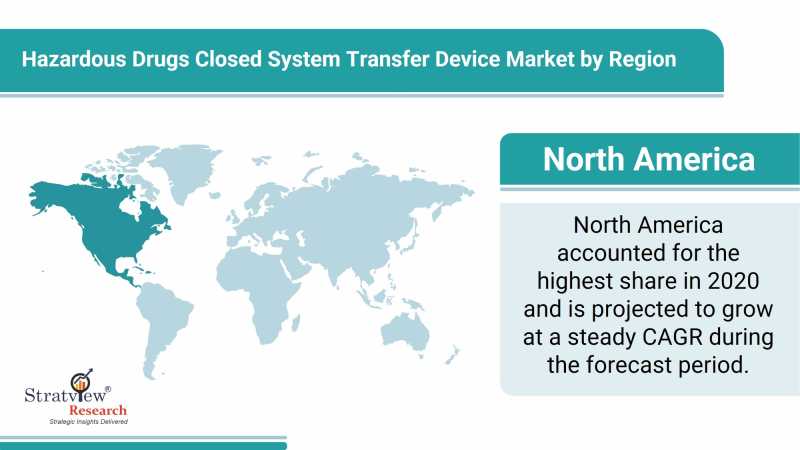
By region, the market in North America accounted for the highest share in 2020 and is projected to grow at a steady CAGR during the assessment period. This is mainly ascribed to favorable initiatives taken by the U.S. Food and Drug Administration and other regulatory bodies in North America to ensure patient safety along with the rising number of oncology drug approvals, which further boosts the regional growth.
Get the full scope of the report. Register Here
Critical Questions Answered in the Report
- What are the key trends in the global market?
- How the market (and its various sub-segments) has grown in the last five years and what would be the growth rate in the next five years?
- What is the impact of COVID-19 on the global market?
- What are the key strategies adopted by the major vendors to lead in the market?
- What is the market share of the top vendors?
Market Segmentation
This report studies the market covering a period of 12 years of trend and forecast. The report provides detailed insights into the market dynamics to enable informed business decision-making and growth strategy formulation based on the opportunities present in the market.
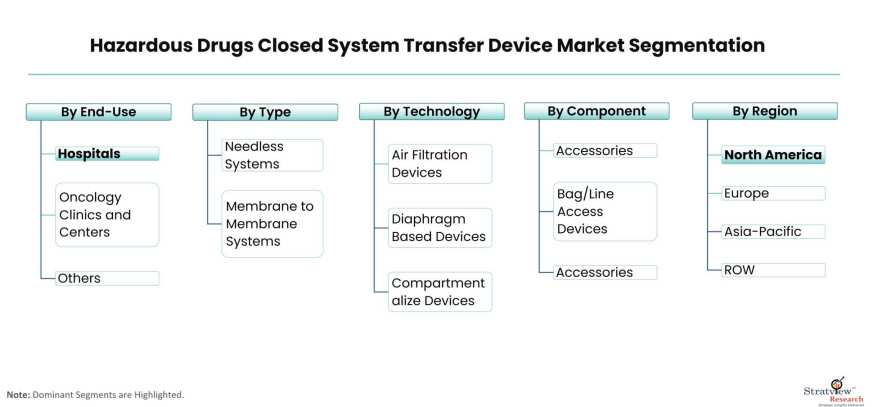
The hazardous drugs closed system transfer device market is segmented into the following categories.
By Type
- Needless Systems
- Membrane to Membrane Systems
By Technology Type
- Compartmentalize Devices
- Diaphragm Based Devices
- Air Filtration Devices
By Component Type
- Syringe Safety Devices
- Vial Access Devices
- Bag/Line Access Devices
- Accessories
By End-Use Type
- Hospitals
- Oncology Clinics and Centers
- Others
By Region
- North America (Country Analysis: The USA, Canada, and Mexico)
- Europe (Country Analysis: Germany, France, The UK, Russia, and the Rest of Europe)
- Asia-Pacific (Country Analysis: China, India, Australia, South Korea, and the Rest of Asia-Pacific)
- Rest of the World (Country Analysis: Saudi Arabia, Brazil, and Others)
Click Here, to learn the market segmentation details.
Target Audience
- Hazardous drugs closed system transfer device companies
- Hazardous drugs closed system transfer device vendors
- R&D companies
- Hospitals
- Drug manufacturing companies
Research Methodology
This report offers high-quality insights and is the outcome of a detailed research methodology comprising extensive secondary research, rigorous primary interviews with industry stakeholders, and validation and triangulation with Stratview Research’s internal database and statistical tools.
More than 1,000 authenticated secondary sources, such as company annual reports, fact books, press releases, journals, investor presentations, white papers, patents, and articles, have been leveraged to gather the data.
We conducted more than 15 detailed primary interviews with the market players across the value chain in all four regions and industry experts to obtain both qualitative and quantitative insights.
Report Features
This report provides market intelligence in the most comprehensive way. The report structure has been kept such that it offers maximum business value. It provides critical insights into the market dynamics and will enable strategic decision-making for the existing market players as well as those willing to enter the market.
What Deliverables Will You Get in this Report?
|
Key questions this report answers
|
Relevant contents in the report
|
|
How big is the sales opportunity?
|
In-depth Analysis of the Hazardous Drugs Closed System Transfer Device Market
|
|
How lucrative is the future?
|
Market forecast and trend data and emerging trends
|
|
Which regions offer the best sales opportunities?
|
Global, regional, and country-level historical data and forecasts
|
|
Which are the most attractive market segments?
|
Market Segment Analysis and Forecast
|
|
Which are the top players and their market positioning?
|
Competitive landscape analysis, Market share analysis
|
|
How complex is the business environment?
|
Porter’s five forces analysis, PEST analysis, Life cycle analysis
|
|
What are the factors affecting the market?
|
Drivers & challenges
|
|
Will I get the information on my specific requirements?
|
10% free customization
|
Report Customization Options
With this detailed report, Stratview Research offers one of the following free customization options to our respectable clients:
Company Profiling
- Detailed profiling of additional market players (up to three players)
- SWOT analysis of key players (up to three players)
Competitive Benchmarking
- Benchmarking of key players on the following parameters: product portfolio, geographical reach, regional presence, and strategic alliances.
Custom Research: Stratview Research offers custom research services across the sectors. In case of any custom research requirement related to market assessment, competitive benchmarking, sourcing and procurement, target screening, and others, please send your inquiry to [email protected].